26 February 2008

Bumper Stickers Round Three: A Pursuit

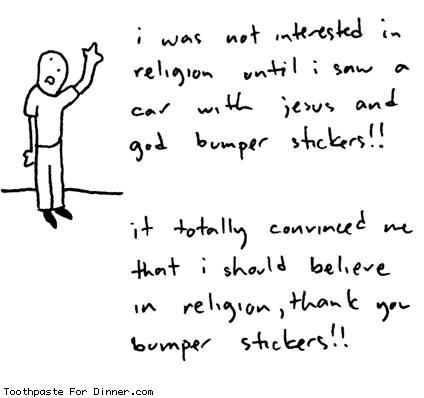
It seems as though bumper stickers have now taken over my life. Before I started writing about them, I hardly noticed or paid any attention to them. Now, after two such posts following the bumper sticker theme, I can’t help but write another one. This one however, is a little different.

It started with, what else, a car. My car to be exact. I was in it and I was driving it. I was driving it on the freeway on my way home from work. I was in traffic so the other cars were all unusually close. Like, five or six feet apart. You can’t leave too much room or you’ll have to give way to the perpetual lane changer than like to roam the streets between the hours of rush and rush.

I was no less than five feet from a red Jeep Cherokee listening to the news, so I wasn’t really paying much attention to my comrade’s rear end. But my eyes glanced across its bumper and my mind read, “Blah, blah, Jesus, blah, blah.”
Insert double take here.
“Jesus,” I exclaimed. “I know that guy.” So, I had to read what the sticker said.

It was at this realization that I was reminded by the perpetual lane changer merging in front of me that I had left too much space between me and the bumper sticker. I’d lost it. Well, almost lost it. I flipped on my left blinker, which is basically useless since the rear blinker light is burned out, dropped into fourth gear, and jammed on the gas to make a pass. A high speed pursuit was under way.

The pass was unsuccessful; remember this was during rush hour. The Jeep was able to get two car lengths up and made a move into the left lane. I was behind. I jumped back over to the right, hoping to ride some of the luck the Jeep had, but nothing. Both lanes were doing the same speed and I was still two lengths down. Then the Jeep made a move for the car pool lane. How could it? There was just the driver, no passenger; as far as I knew. I made a jump back to the left and contemplated breaking the law along with the Jeep. There were no cops along this stretch and I had a straight shot to gain the lost ground I needed on the Jeep to read the bumper sticker and get out of the HOV lane as soon as possible.

I opted not to break the law; too many potential 864-HERO (correction: it's actually 764-HERO) callers out there for my comfort. So, I looked to find a way through the congestion to catch this Jeep before my upcoming exit. I darted back to the right lane and again to the right where there was a bit of space and I hit the gas. I came around a corner and I saw nothing but tail lights. A state patrol officer had someone pulled over on the right shoulder and it was holding back the general flow. Then a semi truck came up on my left and I lost sight of the Jeep. Man! Twelve seconds in the HOV lane and I would have had it, but no. Honest Clayton had to opt toward the law and was stuck in traffic ticket traffic. My exit approached and I left with my head held low.

Now, all this started with a mere glimpse of the name “Jesus.” Something was said about Him and I had to know what it was. Imagine if you will that this was always our reaction when we encounter Jesus. His name, His work, His love, whatever it was that we encountered, we instantly went into a pursuit of Jesus.

Wait, shouldn’t it always be like that? Isn’t Jesus supposed to be so irresistible, so necessary, that when we encounter Him we cannot help but drop everything and follow Him? Uh, yeah. Well, it isn’t is it? Why not? What’s getting in the way?

Is it an HOV lane? We have an opportunity to find out more about Jesus, but the risk is too much. If I do that, I’ll get into trouble. Well, wouldn’t Jesus be worth getting into a little trouble? It seemed that way for people who lost there lives following Him.

The point I’m getting to is there are people who literally risked everything to pursue Jesus; they we completely willing to take on a high speed pursuit for truth. And yet there are those who are afraid they’ll have to take a financial hit if they follow Jesus, they’ll have to take a hit in social status if they follow Jesus, they’ll lose street cred, or whatever.

One of my favorite movie scenes is a scene in Bullitt where Steve McQueen’s character, Frank Bullitt, is chasing after alleged killers of a witness that was in his care. Not only is this the original car chase scene (Like, all the other ones after have copied this one), and not only does it feature a pair or really sweet-ass cars (the new mustang is based off of the one Frank Bullitt drives) that sound amazing on film, but it also demonstrates how far Bullitt was willing to pursue and discover truth. I feel if we aren’t willing to get into a high speed chase for Jesus, we shouldn’t call ourselves His followers.

“But the gateway to life is very narrow and the road is difficult, and only a few ever find it.”
-Matthew 7:14

15 February 2008

Things and the Things We Make of Them: A Retraction.

In regard to my last post, I’d like to print a retraction. A retraction to the statement that “I’ve never cared for bumper stickers.” It’s not that all of a sudden I care for bumper stickers. No, I actually still don’t care for them. But rather, I spotted one today that I actually took a fancy to; one that actually took the subject matter for which it was commenting on and summed it up quite nicely.

The sticker said, “The best things in life are not things.” Simple, concise, yet really deep. (As opposed to the sticker I saw that said, “Honk if you hate people.”) So, let’s think about that for a minute shall we? The best things in life are not things. Why do you think that would be?

Well, for one thing, things cease to be after a certain amount of time passes. So, if one equates “the best” with longevity, then certainly things would not be considered “the best.” But, ultimately it comes down to what you define as “the best.”

Some definitions of “the best” used in society today (as speculated and not proven by the clay):

The best – whatever brings happiness personally at the particular time in question.
Example: That cheeseburger was the best.

The best – something that brings happiness to as many people as possible.
Example: That concert was absolutely the best.

The best – someone or something that wins frequent first place prizes.
Example: Takeru "The Tsunami" Kobayashi is the best hotdog eater ever to eat hotdogs.

The best – the most efficient path or product at doing a particular job or task.
Example: The best way home is to take Interstate 5.

As you can see, the definition of “the best” varies quite a bit. So, in the context of “The best things in life aren’t things,” what “the best” are we referring to? Cheeseburgers? Hotdog eaters? Interstates? Here’s where I think the statement is so brilliant. It takes the understood definitions of “the best” and forces you throw them out when it says the best isn’t things.

Ultimately, things were not meant to be the dominating force in our lives. I’m just going to say that. We were not meant to collect and collect until we die. We were not meant to gather a certain amount of things and sit on them until we die. Things are not what life was meant to be about. Things are nice, yes. They can be very fulfilling at times. I find that when I go hiking, having things make the trips far more enjoyable than if I did not. Hiking boots, backpack, water bottle, socks, pants, etc. all make the outdoor experience very pleasant. But, I could easily spend countless amounts of time and money collecting these hiking things and not enjoy a single one of them. Why? Because all I’m focused on is collecting this stuff rather than using it for the purpose it was intended for; to aid me in enjoying the outdoors.

See, things are essentially tools when you boil it all down. They are meant to help you enjoy life. Life is beyond things. If you live for things, you miss the point; you give out false credit.

Now, this all may be easy to agree with. Sure, it easy to see the superficiality of living life dedicated to things. However, check yourself. Are there earbuds coming out of your ears that you’d be willing to part with? Is there a car in your driveway that you just can’t live without? Are there stacks of DVDs or scores of television channels that you feel are essential to your day to day comings and goings? There’s absolutely nothing wrong with these things, but what’s wrong is our dependence on them; our need to have them in order to feel good.

For example, yesterday being Valentine’s Day a lot of things were exchanged. Also, a lot of things, recently, have been deemed necessary to have a successful February 14th. Chocolate, champagne, boyfriend or girlfriend, dinner reservations, romantic meal, romantic movie, romantic music, romantic card, all of these things are not bad, but certainly we can see the success of a single day does not depend on the existence of such things. I felt my day was quite successful with a frozen pizza, the Ramones, old episodes of The Simpsons, and eventually the movie Capote. I felt that I was able to reflect on how I loved the people around me as well as the people I would come across in the near and distant future quite successfully while munching on a Tony’s Pepperoni pizza.

At the end of the day, when all is said and done, when things take over our lives, people are no longer a priority. In fact, people seem to get in the way of our acquiring more things. This is fundamentally wrong. People should be our priority. Jesus didn’t say, “Love your things like yourself,” but rather, “Love your neighbor.” A neighbor carries a distinct quality that separates itself from things. That is, that a neighbor is alive. A neighbor is alive like you are alive; in the human fashion of being alive. So, people take a priority over things.

This is a difficult lesson to take to practice. Things have been practically wired into our thinking from day 1 and it’s going to take a serious re-wiring to get people in front of things. I’m not speaking from the other side either, I have to same wiring everyone else does. I have earbuds in my ears right now that I think are pretty fundamental in my enjoyment of the day. That’s wrong. But, it just shows I have some work to do.

11 February 2008

Dumb, Dumber, Dubya: How an Assumption Can Make an Ass Out of You and Me.

I’ve never cared for bumper stickers. I find that the issues they represent are 99.9979632% of the time larger, deeper, and more complex than the slogans strapped to automobiles’ rear ends represent. (Although, I’ll admit it would be pretty cool to have a bumper sticker that said, “I’m smarter than your honor student,” or “My other car is another car.”) However, one thing bumper stickers can do is tell you a lot about the owner and operator of the 3 second-slogan-mobile.

For instance, while I was driving to work today there was another car on the road. This other car was a typical Seattle car; small, probably energy efficient in some way or another, contained a political bumper sticker, and had the right blinker stuck on for about 4 blocks. The ironic thing was that the car with a right turn blinker on in the left turn lane had a sticker referencing the intelligence of a, one, current president of a particular country, the United States. It stated, “Dumb, Dumber, Dubya.” Clever I suppose, although alliterations are probably the easiest bit of humor to come up with in my opinion. (Hence, my writings usually have an adequate amount of alliterations all about.)

This bit of irony got me thinking. Is this person aware of everyone’s ability to be dumb now and then? Granted some are more gifted with the ability than others, but still everyone is dumb at some point in their life. So, why do we assume then that our leaders or, more generally, everyone that isn’t our self are immune to making mistakes? It’s like there’s this pedestal and we’re putting people up on it.

Here’s the problem. False assumptions lead to false conclusions. If I start assuming everyone around me isn’t going to make some sort of mistake at some point, then I start expecting perfection out of them. The second they make that mistake, I’m disappointed. If I start assuming everyone around me isn’t going to make a mistake and I, then, make a mistake myself, I look like a fool. I assume no mistakes, I conclude perfection. Perfection is broken, and my conclusion proves false.

Second, where does forgiveness live in a world of perfection? If I assume no mistakes and someone makes a mistake, is it easier or harder for me to forgive that person for their mistake? They broke my expectations. Of course I’m going to find it hard to forgive that person. However, if I assume the correct assumption that is that people will make mistakes, when the mistake comes it’s easier for me to forgive.

Now, you may be asking, “What about people who make mistakes and don’t admit to them? I mean, doesn’t that make them a jerk or something?” Yes. Yes it does. But that doesn’t mean we cannot forgive them. I believe Jesus said, “Forgive them for they know not what they do.” I mean they killed the Son of God and didn’t know it. How jerky is that? But Jesus forgave anyway. If Jesus carried the attitude that these people were incapable of doing such a thing, He might have been a little more pissed off when it happened, but He knew they were capable of such atrocities and was willing to forgive in spite of them.

So, are people capable of being dumb? Absolutely. Are they responsible for their dumbness? Absolutely. Are we as followers of the Great Forgiver expected to forgive? Absolutely. Why is that? Because we can be dumb ourselves, and while we were being dumb, Christ forgave us.

17 January 2008

The Church and Its New Adultery: AKA Faith and Politics.

The race is on. Obama vs. Clinton vs. Edwards vs. Others and Romney vs. Huckabee vs. McCain vs. Giuliani vs. Others. The race for the next President of the United States of America. You’d have to be a penguin living in farthest reaches of Antarctica not to know this is going on. Even then, look out for the Democrats; one of them might come down to kiss you because you’re supposed to be melting and all. Some of us are reveling in this; seeing our 200 plus year old democratic process in action. Some of us are just waiting for them to write dictatorship into the constitution so we don’t have to go through this song and dance every four years. Candidates are spending record amounts of money on campaigns promising fiscal responsibility; flying around in private jets promoting tougher standards on greenhouse gas emissions. It’s difficult to find a side that isn’t all promises and little to no action. Then there’s the fact that I’m a white, middle-classed, Christian male and I’ve already been told with whom I’m suppose to side.

That’s right. Faith and politics is the topic I’ve chosen to tackle this post; the most quintessential taboo subject in the history of all communication. Feathers could be ruffled, toes could be stepped on, feelings could turn uncomfortable; you’ve been warned.

So, what role does my faith and your faith play in our politics? Is it a prominent player; leading the team in points, rebounds, and assists? Or does it sit on the bench; waiting to be called on to fetch water and towels and such? If I’m a Christian, should I only vote for Christians? If I’m a Christian should I not vote for members of another faith when there’s a Christian on the ballot?

Well, for those who do claim a faith, you know it really is inseparable from the rest of your life. The decisions you make stem from what you believe and what you believe stems from the decisions you make. (Yeah, it’s weird.) So to say, “Hey! Put your faith aside!” when it comes to the area of politics is essentially impossible. Then, if you’re a star player, your faith becomes a star player. If you’re a benchwarmer, then your faith becomes a benchwarmer. Plain and simple; you are not detached from your beliefs, nor are your beliefs detached from you.

Now that the detachment of faith from ourselves is established as impossible (be it in very few and probably unconvincing words), the question can really be asked. That is, what role should faith play in politics? I recently read a few things regarding this question. (Hence, why it’s a topic I’m currently writing about. I suppose if I were reading about ducks, I would write about ducks. Maybe I should read more about ducks? Ducks seem to be a far less offensive topic.) One specifically being an opinion article found in U.S.A. Today. The article was entitled “A Plea to Evangelicals – From an Evangelical.” The author, according to U.S.A. Today, a “Distinguished University Professor of Christian Ethics at Mercer University, president of Evangelicals for Human Rights, and author of The Future of Faith in American Politics,” set out to argue that Evangelical conservatives seem to be bringing to the public a form of Christianity that the public may or may not be asking for. I agreed with his argument. Let me highlight a few of his points.

Conservative evangelicalism has become synonymous with Christianity and vice versa. If someone what’s to know where Christians stand on issues, rather than ask the Christians they know, they can look to a conservative evangelical for all the info. According to the author of the article, this is a dangerous position for Christianity to be in.

"Our reputation is at stake, our voice in the culture, and the health of our
religious communities. If the most vocal evangelicals get this wrong, it damages
all evangelicals — all religious believers, really. I am not just talking
about a bit of embarrassment in polite company. If there are people who reject
God or the church, Christianity or religiously inspired moral values because of
what conservative evangelical political activists do, this is disastrous from a
Christian point of view. There are many such people. Here we are at the very
heart of our religious mission, and it is getting fouled up by our
politics."
How has this come about you may ask? He answers. It seems, for the past 20 plus years, Christianity has married itself to the Republican Party. It’s true. Now, I’m no theological expert, but I remember reading somewhere that the Church is Christ’s bride. How can the bride of Christ be married to anything other that Christ itself without committing adultery? It can’t.
"Once any group of Christians gives itself away so completely to a political
party, it ceases to be the church. The church becomes a branch office of the
group's political party of choice — The First Republican Church in
America. This is the root problem, and it leads to all the other specific
mistakes that follow: using the church (or parachurch organizations) and its
considerable resources for direct or veiled candidate endorsements, political
strategizing, dissemination of essentially partisan "voter guides," and
get-out-the-vote efforts. A whole lot more than tax status is threatened when
churches go over so completely to the business of secular politics."
So instead of doing Christ’s work, God’s work, we are doing the work of man.

“Specifically for Christians, we (should) know that the mission of the church is
to be Christ's faithful people, and to do its core work of preaching, teaching
and serving our neighbors. If it is true (as we boldly believe) that the church
is the central location for the work God is doing to redeem the world, then our
focus should be on the church's work, not the state's. As one aspect of our
God-inspired love for our neighbor, we can ask the state and its leaders to do
justice, protect life and advance the common good. We can do this in many quite
constructive ways, from scholarly work to declarations of principles to activism
on specific issues.
But we dare not identify the work of any state, any
political party or any politician with the work of God or the task of the
church. Every time we do so we end up embarrassing ourselves, enraging the
neighbors we are called to love, deepening the culture wars and damaging our own
mission.”
Now, this is not to say that if you are a Christian, or even broader, if you are affiliated with any religious organization, that you cannot claim yourself to a specific political party. This is also not to say that one’s involvement in politics, if the person is religious, should be on a very limited basis. Absolutely not. The danger lies in the Church affiliating itself with anything other than Christ. Thus, as members of this Church (if you proclaim Christ, you are a member), we should first and foremost be affiliating ourselves with Christ.

Where you stand politically may not be the same as your brother or sister in Christ standing right next to you worshiping on a Sunday morning. That’s okay. God created us all uniquely (Interesting isn’t it? How we can all be unique and yet all be of the image of God who is one. Yeah, it’s weird.) and it should just flow naturally from that that we’d think uniquely as well. Unity in the body is not called to be over political issues, but over Christ.

Now, that wasn’t so bad was it? If it was, let me know. The way I like to work and write is by suggestion. So, if there’s something you’d like to hear my thoughts on or you’d like me to experience and write about, let me know that too. I rarely say no to a challenge, so all suggestions are welcome.

04 January 2008

2008: A Goal Odyssey

Goals for 2008

As presented by Clayton Zylstra.

1. Continue looking for opportunities to exercise.

2. Consciously become less wasteful. That means eating the heels of a loaf of bread. That means recycling whenever possible. That means not making unnecessary trips in my car. That means not buying things unless I need them; unfortunately the definition of need will probably fluctuate throughout the year.

3. Become a better overall influence to everyone I come in contact with; physical contact or cyber contact. This goes along with being less wasteful; you know, not wasting opportunities and such. This means having others’ joys, concerns, well-beings before my own, always. This means when I can help someone, I help them. This means when someone doesn’t want my help, I don’t force my help on them. This means if someone doesn’t want to see me anymore, I don’t see them. This means if someone wants to see me more, I see them. This means if someone wants to talk about things I don’t want to hear about, I listen.

4. Climb Mt. St. Helens and Mt. Adams before I leave with Operation Mobilization.

5. Spend an entire month where I buy 0 food. I’d like to see how well I eat without spending money. Hopefully I don’t die.

6. Not die. (I can’t make any guarantees.)

7. Sport a beard of length less than a half an inch and of length 3 inches all in the same month.

8. I won’t have a girlfriend for at least 2 years; I’d like to be satisfied with that fact.

9. Find a deodorant that actually works on me. Not that I smell, but I sweat.

10. Thank a little person.

I shall see how well I met these in 12 months.